AI×HPC Weekly Watch (2026-11-02): AI Cracks Millennium-Level Math, a Trillion-Parameter Model Goes Open-Weight, Compute Moves to Space, and "Model-Defined Chips" Ship
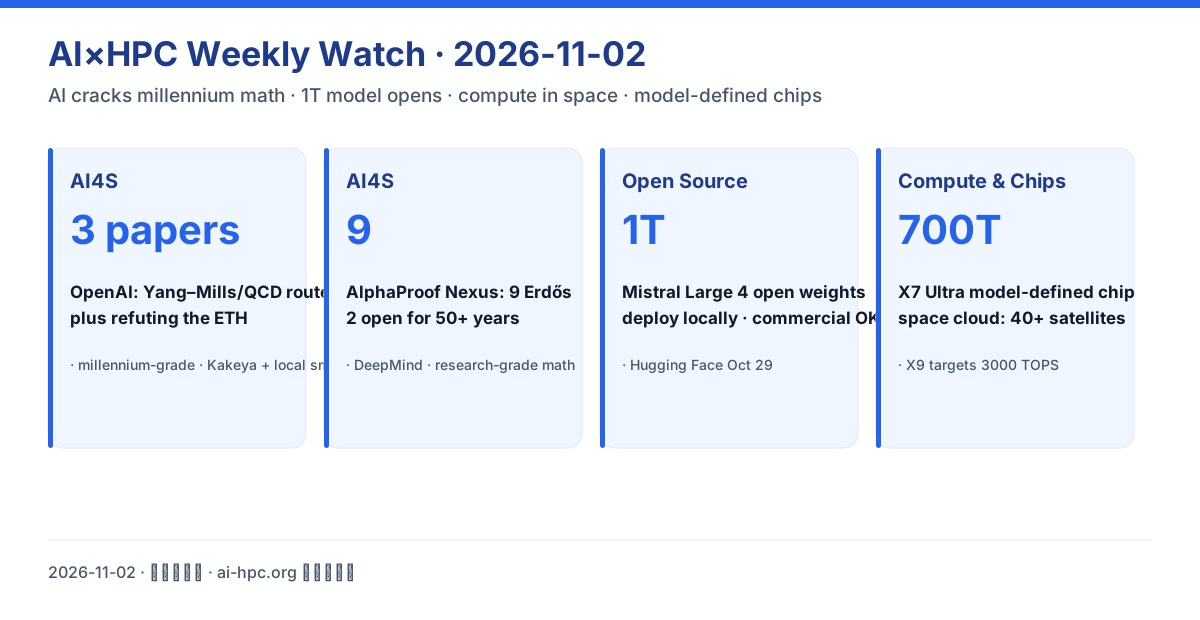
Summary: Between October 26 and November 1, three trajectories stood out in AI×HPC. First, AI moved from "solving problems" to "attacking open human problems" in pure math and theoretical physics — on October 27 OpenAI released three papers that unblocked the renormalization-group route to the 4D Yang–Mills / QCD existence proof, cracked the full-dimensional Kakeya and local smoothing conjectures, and refuted one cornerstone of theoretical computer science, the Exponential Time Hypothesis (ETH); DeepMind's AlphaProof Nexus solved 9 open Erdős problems. Second, open-source hit its trillion-parameter moment — Mistral released the full weights of Large 4 (~1T parameters) on October 29, downloadable and locally deployable with commercial use and modification allowed. Third, compute infrastructure went "space-ground integrated" and "model-defined" — Beijing's Space Compute Innovation Center launched a cloud platform covering 40+ satellites, and XHEART shipped the 700 TOPS X7 Ultra under a "model-defined chip" philosophy with a 3,000 TOPS X9 roadmap.
1. AI×Science: The "AI Problem-Solving Moment" in Math and Theoretical Physics
Three OpenAI papers unblock routes to millennium-grade problems. On October 27, OpenAI released three research papers showcasing frontier models' ability to attack pure mathematics and theoretical physics. First, on the 4D Yang–Mills / quantum chromodynamics (QCD) existence proof, the model carried out the enormous multi-layer integral estimates along the renormalization-group roadmap drawn by mathematician Tadeusz Balaban in the 1980s — a route stalled for decades because it demanded thousands of pages of extremely tedious, error-free computation; the AI acted as a "tunnel-boring machine that never makes arithmetic mistakes" following the blueprint. Second, it cracked the full-dimensional Kakeya Conjecture and the Local Smoothing Conjecture; the local-smoothing proof has been read as three elegant steps — introducing auxiliary coordinates ("ledger keeping in higher dimensions"), establishing a nonlinear PDE with a determinant term ("hooking a new equation"), and reverse-constructing an integral that cancels the bad term ("eliminating by pairing"). Third and most striking, the model refuted the Exponential Time Hypothesis (ETH), a cornerstone of theoretical computer science, by assembling five tools — combinatorial counting (k-SAT), tensor network contraction, code parity checks, polynomial lifting over rings modulo 2k, and Hermite interpolation from numerical analysis — into a precise pipeline. A deep-dive analysis (36Kr) also notes these achievements concentrate in domains "closed within symbol and axiom systems," and that AI has not yet shown the "question-posing" creativity to restructure larger systems (human experts rate only ~3% of AI-proposed math problems as genuinely interesting, improvable to ~33% via a solve-refine-critique workflow) — which does not diminish its speed and correctness within established systems.
DeepMind breaks more Erdős problems. In the same period, DeepMind's AlphaProof Nexus framework solved 9 open Erdős problems in one push, two of which had resisted mathematicians for more than 50 years. The research went public in October, marking AI math capability entering "research-grade mathematics" (conjecture cracking and proof construction) rather than merely olympiad-level problem solving.
Sources: Deep dive into OpenAI's three papers (36Kr, Nov 2) · October global AI roundup (China Sci-Tech Net, Nov 1)
2. Open Source: The Trillion-Parameter Open-Weight Moment
Mistral releases full Large 4 weights. On October 29, France's Mistral AI published the full weights of Large 4 (codenamed "Le Chonk"), its ~1 trillion-parameter, natively multimodal flagship, on Hugging Face — downloadable without application, runnable on any hardware you own: no waitlist, no API-only gate. This build arrived three weeks after the October 6 API preview, with three extra weeks of reinforcement learning driving major gains in coding and defensive cybersecurity, "with improvements still accelerating and no signs of saturation." The license permits commercial use, modification and redistribution; only providers offering inference as a service under separate agreements are restricted. Independent evaluator Artificial Analysis places it in the leading tier among open models. For AI×HPC engineering teams, "deploying a trillion-parameter flagship on your own cluster" is now a plan-able reality — memory, bandwidth and quantization budgets must be re-estimated against open-weight flagships.
Sources: Mistral Large 4 open-weight release (Tech Featured, Oct 30) · AI Daily Digest, Oct 30 (DEV Community)
3. Compute Infrastructure: From Ground Clusters to Space-Ground Scheduling
Beijing unveils a space-ground compute cloud. According to Cailianshe / STCN TechStar Daily on October 30, Beijing Space Compute Innovation Center launched a space-ground integrated compute cloud platform. The platform has completed core functions, covering compute resources of 40+ satellites and achieving unified management and pooled scheduling with ground-based CPU, GPU and NPU resources, supporting space-ground coordinated scheduling for large-model inference workloads. Following the orbital deployment of space compute satellites, this marks the shift of space compute from single-point experiments to platform-level orchestration — a new compute supply shape for reliable, widely distributed edge inference.
Source: Compute channel (Cailianshe / STCN TechStar Daily, Oct 30)
4. Chips & Ecosystem: "Model-Defined Chips" Reach Mass Production
XHEART ships X7 Ultra and discloses X9 roadmap. On October 29, XHEART unveiled the X7 Ultra in Suzhou, delivering 700 TOPS of large-model compute and turning its "model-defined chip" philosophy (deriving chip architecture from real model requirements) into products. Key figures: 98.7% NPU compute utilization measured on production autonomous-driving large models; whole-network fusion in the AI toolchain cutting memory bandwidth consumption by 80% versus industry flagships while raising energy efficiency by 100%; support for a 10× increase in deployable model parameters; China's first mass-produced Armv9 automotive-grade CPU; lidar processing bandwidth up to 20M points/second; ISO 26262 ASIL-B functional safety (on-die MCU ASIL-D certified). In production, the X7 series has been in volume manufacturing for 8 months with cumulative shipments of over 200,000 units, deployed in 10 production vehicle models and booked by 40+ models; dual-X7 L3/L4 compute platforms have won multiple vehicle program nominations. The next-gen X9 targets 3,000 TOPS and 700GB/s on-chip memory bandwidth, planned for 2027. At the event, Momenta CEO Xu Dongxu argued "model-defined chips can deliver 10× performance over general-purpose chips" and that an "autonomous-driving Moore's law" is accelerating; Turing Award winner Jack Dongarra stressed that tight algorithm-software-chip co-design before design freeze, and improving data movement both within and between chips, is the more effective R&D approach for the large-model era — echoing the co-design methodology at the heart of AI×HPC.
Domestic compute ecosystems keep allying. From October 30 to November 1, at the 2026 GAI+C Conference in Beijing, Phytium and the Jiuyuan Intelligent Computing System Ecosystem Consortium released the "Phytium·Jiuyuan joint smart-computing solution," showcasing products built on the D3000M and S5000C-E platforms — pushing domestic compute supply from single chips toward "platform + ecosystem" collaboration.
Sources: XHEART X7 Ultra launch (People's Daily Online / Xinhua client, Nov 2) · Phytium·Jiuyuan solution (official Weibo, Nov 2)
Takeaways for research groups and engineering teams
- AI4S teams: fold "formal verification + large-scale reasoning" into your hard-problem pipeline. This week's OpenAI and DeepMind results show models' proof capability inside closed symbolic systems (math, theoretical physics) is practically useful. Research groups can evaluate formalizing their own problems, handing "thousand-page" derivations to models with verification loops, and checking results with symbolic verifiers — treating AI as a tireless "proof tunnel-boring machine," not just a writing assistant.
- Engineering teams: re-estimate inference resource plans against open-weight flagships. With trillion-parameter weights now open, the constraint on "running a flagship locally" shifts from licensing to hardware. It is worth pre-computing memory/bandwidth/quantization boundaries (e.g., the bandwidth-vs-efficiency tradeoff) and adding open-weight flagships to cluster procurement and inference-stack compatibility matrices (vLLM, TensorRT-LLM, etc.).
- Compute planning: watch heterogeneous pooling and space-ground scheduling. The space compute cloud and the X7 Ultra confirm the same trend from the "scheduling side" and the "chip side": compute is no longer a set of isolated devices but a resource pool that can be centrally managed and dynamically orchestrated by model requirements. When planning the next cluster generation, include heterogeneous management, bandwidth/energy accounting and software-hardware co-design in your evaluation criteria.