AI×HPC Weekly Watch (2026-11-09): An AI-Native Lab Runs 11,000+ Hardware Steps, a 614-PF Supercomputer Goes Live, and Open Weights Get a Safety Gate
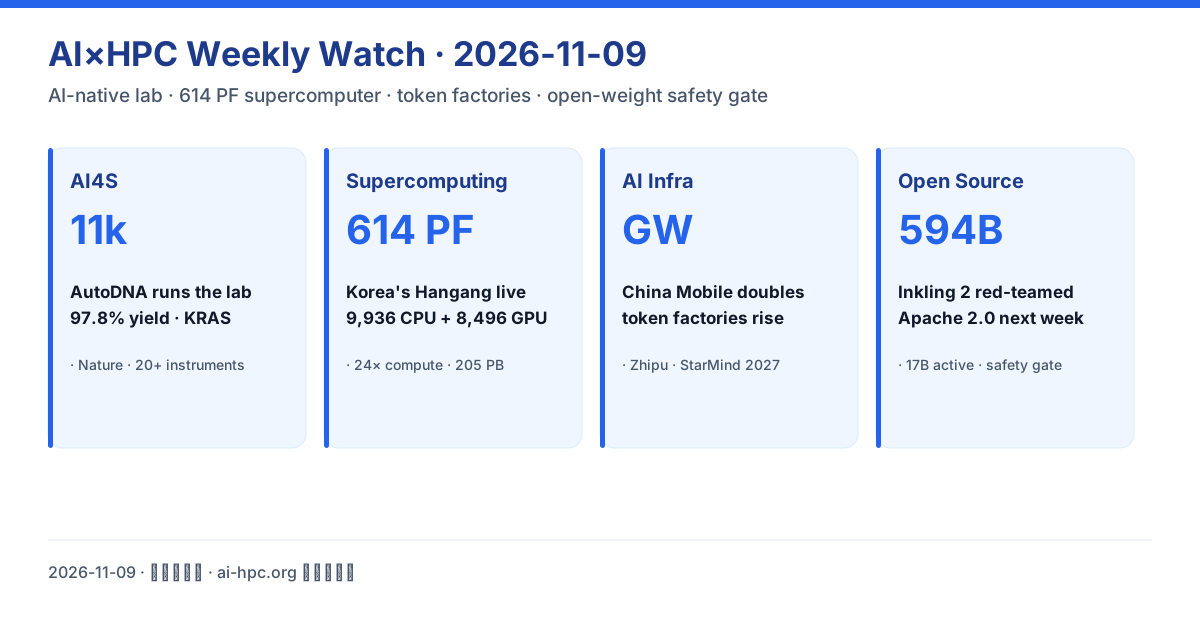
Summary: In the week of November 2–8, four threads of AI×HPC advanced at once. First, AI-native science moved from "assistant tooling" to end-to-end execution: a Shanghai Jiao Tong University team published AutoDNA in Nature, using a multi-agent architecture to turn a natural-language request into 20+ instrument types and 11,382 hardware operations, matching expert-level results in DNA data storage and clinical sample testing; USTC open-sourced the RNA foundation model structRFM in Nature the same week. Second, national supercomputing entered a refresh cycle: South Korea's sixth national system Hangang entered service with 614 PF theoretical peak, 24× the compute of its predecessor, and is reported to be top-10 capable on the upcoming TOP500. Third, the operating logic of AI infrastructure is shifting: China Mobile explicitly frames the transition from IDC to AIDC, from CPU to GPU, and from cloud resource pools to "token factories," doubling AI capacity for two consecutive years, planning multiple gigawatt-scale AI parks, and signing Zhipu to bring GLM onto its cloud; overseas, Vultr launched a 20 MW cluster with 10,000 AMD MI355X GPUs in Chennai. Fourth, open source and space each produced a landmark move: Thinking Machines released the 594B-parameter Inkling 2 Small, with full weights planned for Apache 2.0 after external safety testing and red-teaming; SpaceX and NVIDIA scheduled the first StarMind space AI computers for Q3 2027.
1. AI for Science: an AI-native lab runs a full biomolecular workflow end to end
AutoDNA lands in Nature: one sentence drives 20+ instrument types. On November 4, 2026, a Shanghai Jiao Tong University team and collaborators published An AI-native experimental laboratory for autonomous biomolecular operations in Nature, introducing AutoDNA. The architectural difference from earlier "bolt-on" autonomous labs is decisive: AutoDNA uses multiple agents under a central Planner that coordinates specialists for literature search, reagent management, protocol design, code generation, hardware control, and hypothesis generation. Given a natural-language request, the system autonomously runs the full loop from literature search and reagent selection through experiment design, code generation, hardware execution, and result analysis.
Two engineering pillars: a hardware abstraction layer and a digital twin. The system parses instrument manuals and abstracts device capabilities into natural-language "atomic services" (a pipette, for example, becomes transfer and mix), after which a code agent generates control code and self-corrects. As a result, AutoDNA coordinates more than 20 instrument types and executes over 11,000 hardware operations at micron-level positioning and microliter-level liquid handling. Before execution, the system rehearses generated instrument code in a simulated environment, tracking liquid volumes and checking positions and settings; in one run, the simulation caught code attempting to read fluorescence before the sample container had been loaded, blocking the error ahead of costly real-world execution.
Four representative applications, with checkable numbers. In nucleic-acid testing, the system ran a commercial fluorescent isothermal kit to detect African swine fever virus. In enzymatic de novo DNA synthesis, AutoDNA optimized two competing objectives—yield and time—without a human-defined search space, reaching 97.8% average per-step synthesis yield, comparable to published expert-optimized results, while cutting concurrent workflow execution time to roughly one third. In DNA data storage, the system synthesized and sequenced 78 DNA strands, ran for about 203.5 hours across 11,382 hardware operations, and exactly restored the original digital content. In cancer detection, given a preprocessed colorectal tumor sample with unknown sequence information, it autonomously completed five stages—sequencing, mutation identification, primer design, primer synthesis, and assay validation—identifying a KRAS G13D mutation and validating it with self-synthesized primers.
The limits are worth recording too. In an accompanying commentary, James Zou, associate professor of biomedical data science at Stanford University, notes that task selection and physical platform configuration remain human work, and that long runs still require reagent replenishment and waste cleanup. Of 14 hardware errors recorded during AutoDNA runs, 8 were recovered automatically and 6 required human intervention; LLM stochasticity can also affect protocol reproducibility. The team plans stronger instruments, mobile robots that can transport reagents autonomously, and retrieval-augmented literature access. For AI×HPC teams, the value here is not "unmanned" operation but a working engineering loop—design, experiment, optimize—with graded error recovery.
The same week, an RNA foundation model went open source. On November 5, the RNA sequence foundation model structRFM from USTC's medical imaging intelligence and robotics lab appeared in Nature. Applying foundation-model methods to RNA structure prediction and function inference, it delivered a series of performance gains and has been open-sourced, offering a new tool for life-science research and drug discovery.
Sources: AutoDNA lands in Nature (36Kr, Nov 5) · Paper (Nature) · structRFM coverage (USTC News, Nov 6)
2. Supercomputing: South Korea's sixth national supercomputer Hangang enters service
614 PF, 24× its predecessor. On November 2, South Korea's Ministry of Science and ICT announced that the sixth national supercomputer, Hangang, had entered service. The system uses a CPU + GPU hybrid architecture with NVIDIA GH200 superchips: 9,936 CPUs and 8,496 GPUs, 614 PF theoretical peak. Against the fifth-generation Nurion from 2018, compute is 24× higher, storage 10× larger (205 PB), and network performance 4× higher (400 Gbps), with system-level AI capability for the first time.
Applications are configured directly for "AI plus science." According to the published allocation, the Korea Meteorological Administration will run 72 PF or more for numerical weather prediction, while semiconductor design, materials science, biomedical research, computational chemistry, and data logistics gain AI capability. Coverage reports that the system is capable of entering the top 10 of the November 2026 TOP500 list; the new list is due later in November, when the claim can be checked.
The refresh is about more than peak. Storage and network scaled 10× and 4× from Nurion to Hangang, which says the bottleneck diagnosis for national systems has moved from "how fast can it compute" to "how well can it be fed": under AI workloads, data supply and interconnect determine how much of the peak is actually realized. That matches what the converged AI-HPC approach has shown elsewhere.
Sources: Hangang enters service (IT之家/Sina Tech, Nov 2) · Hangang at 614 petaflops (PricingRank, Nov 3)
3. AI infrastructure: carriers run compute as a "token factory"
China Mobile: AI capacity doubling for two years, multiple gigawatt-scale parks. Between November 6 and 8, China Mobile disclosed its compute roadmap: compute is this year's largest investment increment; on top of multiple 10,000-GPU clusters already built, it is laying out multiple hyperscale AI clusters; AI capacity will double for two consecutive years, and multiple gigawatt-scale AI parks will be built. The carrier is also pushing compute-network integration, 400G OTN, hollow-core fiber, and CDN expansion. More telling is the shift in operating language: from IDC to AIDC, from CPU to GPU, from cloud resource pools to "token factories"—compute build-out is no longer only about input but about output.
On November 8, China Mobile Cloud signed with Zhipu. The agreement covers domestic compute adaptation, token technology, model services, product development, and industry commercialization: Zhipu's GLM models will connect to China Mobile Cloud's MoMA model service platform, and the two plan a joint token development center, AI Coding products, and deployments in finance and government. The carrier supplies compute and channels, the model vendor supplies models and engineering—an operating model billed by token and delivered by industry is taking shape.
Overseas capacity expands on a different cadence. On November 2, US cloud infrastructure provider Vultr launched a 20 MW AI supercluster in Chennai on 10,000 AMD Instinct MI355X GPUs, its largest AI deployment in India to date, with a target of 1 GW in India by 2029. Within one week, carrier-scale gigawatt parks and third-party 20 MW single sites coexist—evidence that compute expansion has shifted from "grabbing GPUs" to "grabbing power, land, and delivery cycles."
Sources: China Mobile's AI compute plans and "token factory" (Guangming/Toutiao, Nov 8) · China Mobile and Zhipu agreement (Securities Times, Nov 8) · Vultr Chennai 20 MW cluster (Elets CIO, Nov 2)
4. Compute goes to space: StarMind scheduled for Q3 2027
Musk puts a timeline on space AI computers. On November 6 local time, speaking at the Baron Investment Conference, Musk said the StarMind space AI computer, co-designed by SpaceX and NVIDIA, is expected to launch its first units in Q3 2027, reach meaningful scale in 2028, and expand further in 2029. SpaceX has already placed satellites carrying NVIDIA GPUs and Google TPUs into orbit, an early validation of AI chips operating in space.
The trade-off against terrestrial data centers is power and heat. Compared with ground-based facilities, space deployment swaps "power and cooling cost" for "radiative surface area, launch mass, and in-orbit maintenance," which makes orbital compute a better fit for low-latency, wide-coverage, hard-to-wire inference than for replacing terrestrial training clusters. Last week Beijing's space compute cloud pooled 40+ satellites with ground CPU/GPU/NPU resources; this week SpaceX added a hardware timeline—"space-ground integrated scheduling" is advancing from both the platform and the hardware side.
Source: StarMind timeline (Boss Live/Weibo, Nov 9, relaying Nov 6 remarks)
5. Open source: open weights get a safety gate
Inkling 2 Small: 594B parameters, weights "next week" but after red-teaming. On November 5, Thinking Machines Lab released its second-generation model Inkling 2 Small—a 594B-parameter, 17B-active multimodal model (text and image in, text out), currently available through the Tinker platform at $0.30 per million input tokens and $1.00 per million output tokens. The company stated that full weights are planned for an Apache 2.0 release the following week, after external safety testing and red-teaming, describing the arrangement as "a safe path to open weights."
"Verify before opening" is becoming a release pattern. For the past two years the norm has been model card and weights on the same day; Inkling 2 Small puts safety evaluation ahead of weight release, creating a three-stage sequence of hosted availability, external testing, then open weights. The effect cuts both ways: compliance risk goes down, but certainty about when weights can actually be downloaded goes down too, so roadmaps that depend on open weights need a waiting window. License differences matter as well—the first-generation Inkling (released July 15, 2026) is Apache 2.0, while Inkling 2 Small operates under Tinker Terms of Use until weights open; the two should not be conflated.
Sources: Introducing Inkling 2 Small (Thinking Machines Lab, Nov 5) · Inkling 2 Small model card · Independent analysis (Unite.AI, Nov 5)
Takeaways
- AI4S teams: build a rehearsal layer and graded error handling before "unmanned" labs. AutoDNA's credibility comes from two things: pre-execution digital-twin rehearsal, and splitting 14 hardware errors into 8 auto-recovered and 6 requiring humans. When adopting autonomous lab platforms, standardize instrument interfaces into atomic services and version-control protocols first; otherwise every device becomes a custom engineering project.
- Engineering teams: estimate compute cost by tokens produced, not GPU-hours consumed. Turning cloud resource pools into "token factories" means procurement and billing will migrate toward model-service output. Inference stacks should support integration with carrier model platforms (MoMA-class), domestic accelerator adaptation, and multi-tenant metering; capacity planning should treat "cost per token plus delivery latency" as a peer metric to "cost per GPU-hour."
- Open-source governance: treat "weights availability date" as an assumption, not a promise. With safety testing now preceding open weights, teams that build product roadmaps on an open flagship should budget a one-to-two-week waiting window by default, prefer versions that have completed external testing in compliance-sensitive settings, and verify license type—Apache 2.0 and vendor-specific terms differ substantially on commercial use and redistribution.