AI×HPC Weekly Watch (2026-11-16): SC26 Opens as TOP500 Changes Hands, Hangang Counts Down to Service, and Chinese Compute Ships in Containers
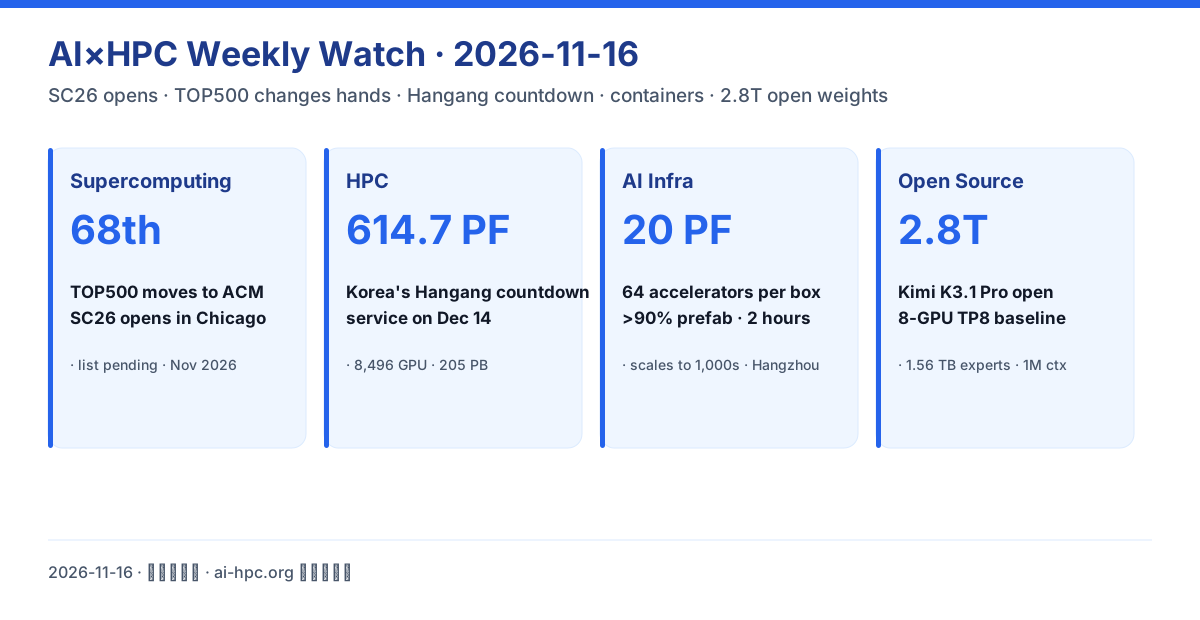
Summary: Over the past week (November 9–15), AI×HPC shifted from "shipping products" back to "setting rules and preparing delivery." First, the supercomputing calendar reached its annual milestone: SC26 opened in Chicago on November 15, and the 68th TOP500 will be released during the conference — the first list produced after the TOP500 project moved from ISC Group to ACM/SIGHPC. As of this writing the official list page still shows the 67th edition from June, so the new list has not yet gone live. Second, a national supercomputer is entering its final pre-service phase: Korea's sixth national system, Hangang, is confirmed to enter full service on December 14, with resources split roughly 55% for R&D, 30% for national strategy and 15% for industry; the government's guidance is "a global top-10 position," while the measured ranking still awaits the new list. Third, the delivery model for Chinese compute is changing: at IC China 2026, converged supercomputing/AI systems appeared alongside distributed compute containers — 64 in-house accelerators per 20-foot box, 20 PF in FP16, over 90% prefabrication, and on-site deployment in as little as two hours, turning data-center construction into a product shipment. Fourth, the floor for open weights became explicit: Kimi K3.1 Pro released 2.8-trillion-parameter weights with day-0 vLLM support, but an eight-GPU TP8 baseline and roughly 1.56 TB of routed-expert weights make "download and self-host" an illusion.
1. The list: SC26 opens, and the 68th TOP500 changes hands
The conference itself. SC26 (International Conference for High Performance Computing, Networking, Storage, and Analysis) runs November 15–20, 2026 in Chicago, with exhibits from November 17–19.
The real change is who runs the list. Since 1993, the TOP500 project had been supported and maintained by ISC Group. Under the transition, ownership moves to ACM, with ACM's SIGHPC (Special Interest Group on High Performance Computing) taking the central operating role. Per SIGHPC's public note, a steering committee guides strategy and a technical committee of SIGHPC and ACM volunteers produces the list; Horst Simon, Jack Dongarra and Eric Strohmaier remain on the steering committee for as long as they wish to stay involved. The first list produced under the new structure is the 68th edition, scheduled for November 2026, and the project is meant to remain free, publicly accessible, vendor-neutral and connected to the broader HPC community.
What qualifies for this edition is spelled out. Under the TOP500 submission rules, the deadline for new sites for the November release is October 24; all reported systems must be installed by November 1, and November 1 is also the last date for Linpack updates. In other words, the November list captures systems that were already installed and had run HPL by November 1 — clusters that lit up in early November generally wait for the next edition.
As of November 16, the official list page still showed the June 67th edition. The 68th list had not yet gone live when this article was written, so this week's development is "the conference opened and the list entered its release window," not "a new list is out."
For reference, the June baseline has LineShine at No. 1, installed at the National Supercomputing Centre in Shenzhen: 2.198 EF on HPL against a 2.736 EF theoretical peak — roughly 80% efficiency — across 13,789,440 cores built on 304-core LX2 processors at 1.55 GHz, the LingQi interconnect and Kylin OS, drawing about 42.2 MW for 52.07 GF/W; it also leads HPCG at 22.00 PF. It is followed by El Capitan (1.809 EF), Frontier (1.353 EF), Aurora (1.012 EF) and JUPITER Booster (1.000 EF), five systems above the exascale threshold at once. KAIROS still tops Green500 at 73.28 GF/W.
An easily missed detail: on HPL-MxP (mixed precision), LineShine reaches 7.92 EF — only 3.6× its HPL score — for fourth place, while El Capitan achieves 16.7 EF (9.2×) and Aurora 11.6 EF (11.5×) on GPU acceleration. The gap says a CPU-only architecture can win on double precision but not on low precision — for systems on a converged supercomputing/AI path, multi-precision and matrix acceleration on the CPU side is the next capability to close.
Sources: SC26 dates and deadlines · TOP500 ownership transfer to ACM SIGHPC and the 68th edition · TOP500 submission rules and timing · TOP500 list archive (latest still June 2026) · 67th list release: LineShine debuts at No. 1 with Top 10 details
2. National supercomputing: Hangang enters its countdown to service
Service date fixed. A November 5 publication by the Korean government's policy weekly states that the sixth national supercomputer, Hangang, will enter official service on December 14. On November 2, the Ministry of Science and ICT and the Korea Institute of Science and Technology Information (KISTI) already held a launch ceremony at KISTI headquarters in Daejeon with about 200 representatives from industry, academia and research; the system is currently in trial operation.
Hardware and performance. The machine carries 8,496 GPUs — including NVIDIA GH200 CPU-GPU superchips — and 9,936 CPUs, with a theoretical peak of 614.7 PF, 205 PB of storage and network bandwidth above 400 Gbps. Against Nurion, the fifth system that entered service in 2018, that is 24× the theoretical compute, 10× the storage and 4× the network performance. Reported project cost is about 382.5 billion won (roughly USD 276 million).
How resources are split, stated explicitly for the first time. Three programs divide the full capacity: the R&D innovation program takes about 55% and is open to researchers at universities, government-funded institutes and companies; the national strategy program takes about 30% for national strategic technology work, including K-Moonshot and the seven SEED programs; the industrial innovation program takes about 15%, aimed at small and venture firms that cannot build their own HPC infrastructure. The 55/30/15 split is a public answer to the perennial question of how public compute balances paper output against industrial conversion.
The ranking question cannot be settled this week. Korea's stated expectation is a position inside the global top 10. In our 2026-11-09 issue we noted "reported to be top-10 capable, pending the list"; this week we have to be precise: as of November 16 the 68th list had not been published, so there is no official rank. A Middle East outlet reported on November 9 that Hangang measured 342.6 PF on TOP500 testing for 12th place globally — that figure is not confirmed by Korea or by TOP500 and is treated here as unverified.
If that measurement holds, one piece of arithmetic is worth recording: 342.6 PF against a 614.7 PF theoretical peak implies HPL efficiency of about 55.7%. For a GH200-based machine with more than eighteen thousand chips, fifty-something percent HPL efficiency sits in a normal band — what usually caps efficiency is not the GPU itself but intra-node interconnect, east-west bandwidth and whether the job can scale to fill the machine.
The roadmap already points at quantum. Korea reportedly plans to link Hangang with an IonQ Tempo quantum system in 2027, forming a hybrid classical-quantum stack: the quantum side screens protein targets suitable for drug development, and Hangang estimates the energy required for those processes. The hard part is not the link but task partitioning and scheduling — deciding which stage goes to the quantum system and which stays classical requires a job layer that can express both resource types.
A practical constraint worth recording. Equipment procurement slipped because AI demand and GPU prices rose together: the project passed an economic feasibility review in 2022, but early procurement rounds failed, forcing supervisors to re-plan implementation around researchers' changing needs. "Money does not guarantee cards" has carried over from 2023 into today and is a shared condition of public compute programs worldwide.
Sources: Hangang enters official service on December 14 (K-공감, Korea government policy weekly, Nov 5) · Project budget and scale (The Morning Pulse, Nov 5) · Reported measured rank and 2027 quantum link (Nabd, Nov 9; unverified)
3. Chinese compute: converged systems and containerized delivery on one floor
On November 12, the 23rd China International Semiconductor Exhibition opened at the China National Convention Center in Beijing, themed around "new-quality productivity of chips and new momentum for intelligence," putting chip innovation, compute infrastructure and AI convergence on the same floor. What domestic vendors brought was not only chip specifications but "how the whole system gets delivered."
Route one is converged supercomputing and AI. Taichu Yuanqi showed its in-house HCU heterogeneous many-core architecture, the Yuanqi T2 Ultra chip launched this year, and the companion Yuanqi HyperIntellix system — whose goal is to break the traditional split between separate supercomputing and AI compute stacks and to schedule both resource types jointly. As a platform-level companion, its domestic AI4S compute platform is live and stable; by its account it works with nearly 20 domestic universities, institutes and companies across climate and weather, quantum mechanics, biomedicine and low-altitude economy, with more than a hundred small firms and developers using the platform. Its COO's framing at the concurrent IC entrepreneur conference is worth recording: cloud customers' business is essentially "inference as revenue," efficiency is measured by effective throughput, system-level compute platforms are becoming mainstream, and raising parallel efficiency while lowering parallel cost is the new core problem.
Route two is putting the data center into a shipping container. The distributed compute container on display packs 64 in-house AI chips into a 20-foot air-cooled box rated 20 PF in FP16; the same line offers 45-foot units, supports air and liquid cooling, can be configured up to 256 accelerators per box and scaled horizontally into thousand-accelerator clusters. The differentiator is delivery speed: over 90% prefabrication, on-site deployment and commissioning in as little as two hours, and more than 70% better delivery efficiency than conventional AI cluster builds. The first deployed unit is already running in Hangzhou, and the design supports nearby renewable power supply and compute-power coordination.
Why this belongs in a weekly watch. The pain of conventional AI data-center builds has been repeated for years — long cycles, high cost, often a year or more. Containers move civil and electromechanical work into the factory, leaving only placement, wiring, power-up and integration on site. For fast expansion or emergency capacity (research institutes, industrial sites, regional compute nodes), this compresses "time to compute" from a project scale to weeks or hours.
Its limits are equally clear: a box solves delivery of the compute unit, not the power capacity, inter-box high-speed fabric, operations model or scheduling platform. To reach thousands of accelerators, east-west networking and cooling still need data-center-grade design — the prefabrication dividend depends on whether the supporting infrastructure is modularized on the same principle.
Source: IC China 2026: domestic converged supercomputing and compute containers (Nov 12)
4. Open source: 2.8 trillion parameters open, but eight GPUs is just the starting line
Get the timeline right. Moonshot AI introduced Kimi K3.1 Pro on October 24; on November 4 the official Hugging Face repository published the model card, configuration, weights and a dedicated license, and the vLLM team shipped day-0 serving support the same day; on November 5 Together AI listed the model on serverless inference. Weights and a serving path arriving together is the most informative open-source development of the week — historically "open" often meant weights without a usable runtime, leaving engineering teams to walk the minefield themselves.
The specification is demanding: 2.8 trillion total parameters with 104 billion activated per token; 896 routed experts with 16 selected per token plus shared experts; of 93 layers, 69 use Kimi Delta Attention and 24 use gated sparse attention, the latter adding a Gated DeepSeek Sparse Attention indexer that selects up to 2,048 previous tokens to cut the KV data read during long-context decoding; a 1,048,576-token context window; weights stored in MXFP4 with MXFP8 activations.
Deployment reality matters more than parameter count: the current vLLM recipe requires vLLM 0.34.0 or later (while the latest tagged stable release on GitHub as of November 5 was still 0.33.0), and the MXFP4 baseline is TP8 — eight GPUs across two GB300 trays, one B300 node or one MI355X node; routed-expert weights alone occupy roughly 1.56 TB on disk. It supports NVIDIA, AMD, Google TPU and Alibaba T-Head Zhenwu PPU paths, but published numbers are hardware-specific and should not be read as identical performance across accelerators.
Performance numbers: for a 340K-token prompt, token-sharded versus head-sharded prefill delivers up to 1.69× faster time to first token on eight GB300 GPUs; AgentX results reach up to 375.9 output tokens per second per user and 37.8K tokens per second per GPU.
Read the license: this is open-weight, not a standard open-source license. As described publicly, a model-as-a-service operator whose aggregate revenue exceeds USD 20 million over a consecutive 12-month period must enter a separate agreement before commercial use; products above 100 million monthly active users or USD 20 million in monthly revenue carry a model-name display condition; exceptions cover internal use and access through official products or certified inference partners. On pricing, Together AI's serverless listing was USD 2 per million input tokens, USD 10 per million output tokens and USD 0.20 per million cached input tokens.
The engineering conclusion is blunt: 2.8 trillion parameters do not shrink because the model is sparse. 104 billion active parameters converge the per-token compute path, but the full checkpoint must still land on disk and be schedulable — if memory, storage or interconnect falls short on any one of the three, self-hosting is out of reach. Openness lowers the barrier to access, not the barrier to deployment.
Source: Kimi K3.1 Pro weights, vLLM day-0 support and hardware baseline (Nov 6)
5. What it means for research groups and engineering teams
One: put peak, measured and mixed-precision figures into acceptance clauses. Hangang's 614.7 PF is a theoretical peak, HPL is what ranks a list, and HPL-MxP is a third yardstick; LineShine shows one machine can sit at wildly different positions across the three. Procurement and acceptance documents that omit "which metric, at what job size" almost guarantee later disputes. For inference- or low-precision-training-heavy workloads, HPL rank has limited value; specify effective throughput on your own models and context lengths instead.
Two: compute delivery is becoming a product module, and the surrounding infrastructure must be modularized too. Containers cut deployment to hours only when power, cooling, networking and operations follow the same modular logic; otherwise on-site rework eats the gain. And "nearby renewables, compute-power coordination" is not marketing — it determines electricity structure and the PUE ceiling, worth aligning with the energy side at design time.
Three: the selection order for open weights should be deployment baseline → license → capability. First check whether you can meet an eight-GPU TP8 baseline and load terabyte-scale weights, then check whether the license's revenue or scale thresholds apply, and only then compare leaderboard scores. In reverse order, engineering constraints usually veto the decision at the last step.
Appendix: key numbers this week
| Item | Key figures | Basis |
|---|---|---|
| 68th TOP500 | Scheduled for November 2026, during SC26 (Nov 15–20) | SIGHPC announcement |
| Inclusion window | New sites due Oct 24; systems installed by Nov 1; Linpack updates due Nov 1 | TOP500 submission rules |
| No. 1 in 67th list (LineShine) | HPL 2.198 EF (peak 2.736 EF, ~80%); HPCG 22.00 PF; 42.2 MW; 52.07 GF/W | TOP500 release |
| Mixed precision, 67th list | El Capitan 16.7 EF (9.2×), Aurora 11.6 EF (11.5×), LineShine 7.92 EF (3.6×) | TOP500 release |
| Korea's Hangang | 614.7 PF theoretical; 8,496 GPUs + 9,936 CPUs; 205 PB; 400 Gbps+ | Korean government policy weekly |
| Service date and allocation | Official service Dec 14; R&D 55% / national strategy 30% / industry 15% | Korean government policy weekly |
| Hangang, measured (unverified) | Reported HPL 342.6 PF, 12th globally (≈55.7% efficiency) | Foreign report, unconfirmed |
| Containerized compute | 64 accelerators / 20 PF FP16 per box; up to 256; >90% prefabricated; two-hour deployment | IC China 2026 on-site report |
| Kimi K3.1 Pro | 2.8T total / 104B active / 1,048,576 context / TP8 baseline / ~1.56 TB expert weights | vLLM deployment recipe |
Next week: the official 68th TOP500 with Green500 and HPCG results (including Hangang's first ranking); new system announcements and the Gordon Bell Prize at SC26; and which edition clusters lit up after November 1 will land in.