AI-HPC Converged Architecture: The Knowledge Base as a Book
This knowledge base is organized like a professional book: 15 chapters, progressing from accounting to hardware, systems, compilers, models and applications. This "core architecture" page is the book's overview — see how layers and chapters depend on each other first, then decide where to start reading.
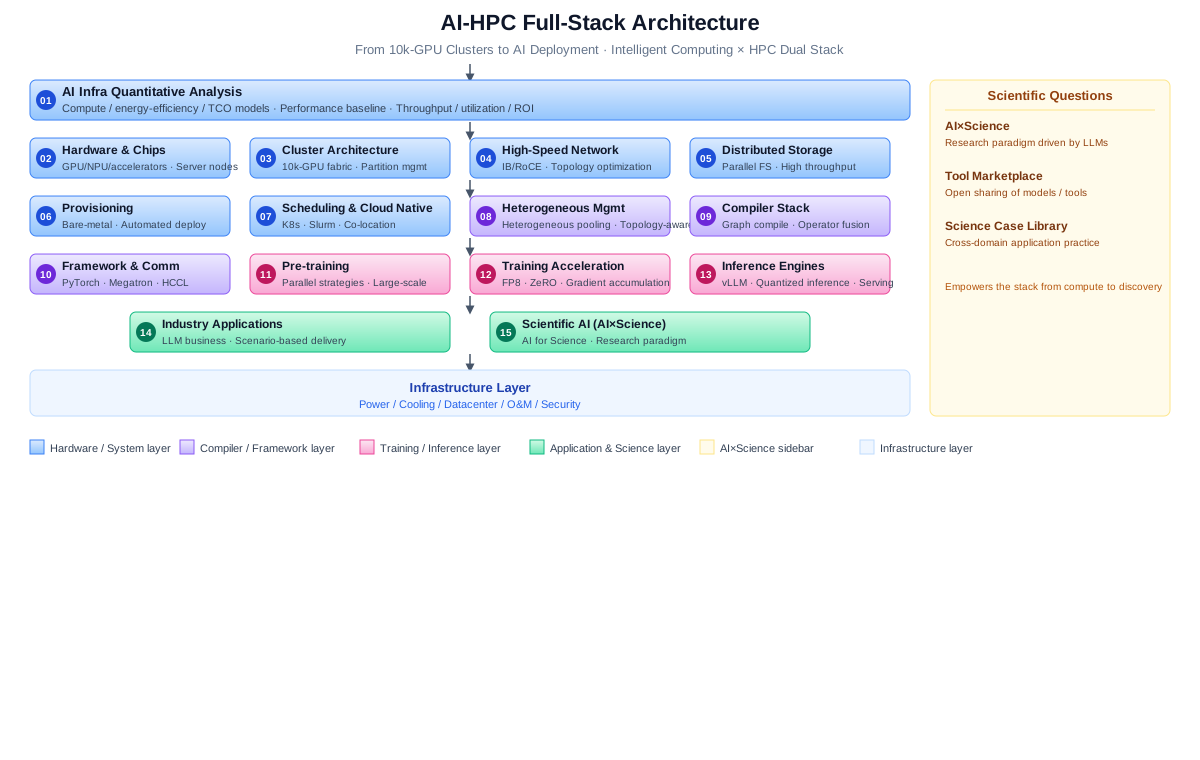
Above: the AI-HPC full-stack overview (click to enlarge), from infrastructure through system software, LLM technology, to applications and scientific computing.
Six Parts: 15 Chapters in Six Progressive Layers
The whole book is organized into L0 → L5 layers, each spanning one or more chapters. Layers depend on each other progressively: every design decision in a layer builds on the physical constraints of the layer below.
| Part | Layer | Chapters | What this part covers | What you gain |
|---|---|---|---|---|
| Part 0 | L0 Quantitative Methods | 01. AI Infra Quant | Do the math first: memory, compute and bandwidth ledgers | Derive any architecture choice yourself |
| Part 1 | L1 Hardware & Infrastructure | 02. Hardware & Chips → 03. Cluster Architecture → 04. Network → 05. Storage | Every brick of the compute base | Read server/cluster/network/storage specs and topologies |
| Part 2 | L2 System Software & Scheduling | 06. Provisioning → 07. Scheduling & Cloud → 08. Heterogeneous | Turning hardware into a usable platform | Deliver and schedule a cluster independently |
| Part 3 | L3 Compilation & Frameworks | 09. AI Compiler → 10. Frameworks | From model graph to high-performance kernels | Understand how operators become GPU code |
| Part 4 | L4 Model Engineering | 11. Pre-training → 12. Distributed Training → 13. Inference | Efficient training and inference at scale | Design and tune training/inference plans |
| Part 5 | L5 Applications & Science | 14. Industry Apps → 15. AI×Science | Turning compute into business and scientific output | Land industry apps, understand AI×Science |
Inter-Layer Dependencies: Why This Order
Chapter prerequisites are not arbitrary — they follow the flow of data and knowledge:
L0 Quantitative Analysis (runs through the whole book, revisit anytime)
        │ defines "how much data to move, how much compute needed"
        ▼
L1 Hardware Base (01→04) ─── physical constraints: bandwidth, latency, capacity, power
        │ provisioning/scheduling must understand hardware topology (05 depends on 02; 03 caps NCCL)
        ▼
L2 System Software (05→07) ─── turn hardware into a usable platform
        │ compilers/frameworks depend on heterogeneous drivers and scheduling (08 on 07; 09 on 08)
        ▼
L3 Compilation & Frameworks (08→09) ─── operator generation and framework runtime
        │ training performance depends on framework + comm libraries (11 on 09/03)
        ▼
L4 Model Engineering (10→12) ─── training and inference engineering
        │ apps depend on inference engines and scheduling (13 on 12/06)
        ▼
L5 Applications & Science (13→14) ─── business and scientific output
Three Reading Paths
Choose your entry by role — you do not need to read chapter 1 through 15:
| Your goal | Recommended path | Why |
|---|---|---|
| Full-stack cognition | L0 → L1 → L2 (01 → 02 → … → 08) | Do the math, learn the hardware, then delivery — the fastest complete picture |
| Deliver clusters independently | L1 → L2 full (02 → 08; the L40S series lives in 03) | Hardware checks, network, provisioning, scheduling — the full delivery chain |
| Algorithm/model engineer | L4 → L5 (10 → 14), revisit L0 as needed | Focus on training and inference; return to L0 when resource-bound |
Full-Stack Technology Components (vs. the Diagram)
| Layer | Technology | Chapter |
|---|---|---|
| Applications | PyTorch, TensorFlow, OpenMM, GROMACS, vLLM | 09 / 11 / 12 / 13 |
| Scheduling | Slurm, Kubernetes, containers | 06 |
| Communication | MPI, NCCL, UCC | 02 / 03 |
| Drivers | CUDA, ROCm, domestic accelerator runtimes | 07 |
| Interconnect | NVLink, InfiniBand, RoCE v2 | 03 |
| Storage | Lustre, BeeGFS, GPFS, All-Flash cache | 04 |
Tip: first-time visitors should start at the Knowledge Overview. To place a single article in context, return to this page to see which layer it belongs to and which chapter precedes it.