13. Application Landing: From Science to Software
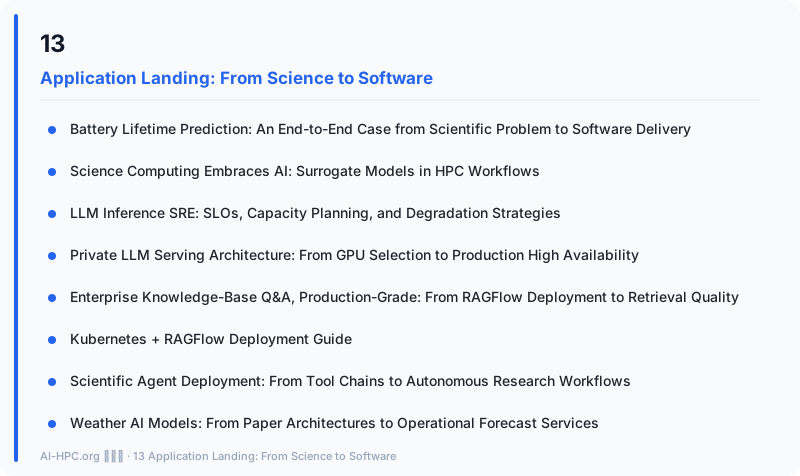
Chapter focus: This chapter answers an engineering question: "how does a scientific method become deliverable software?" Five complete cases — battery-lifetime prediction, HPC surrogate models, private LLM serving, production-grade knowledge-base QA, and scientific agents — cover the full chain from problem definition, data, and models to validation and delivery.
🧭 Reading Map
- Prerequisites: 13. Inference Engines — app delivery depends on stable inference services
- Role: opening of Part 5, L5 — RAG, agents, private LLM serving and scientific surrogate models
- Order: RAG production stack → private serving/ops → agents & scientific applications
- Next: 15. AI×Science — from industry back to science
Articles
Battery Lifetime Prediction: An End-to-End Case from Scientific Problem to Software Delivery
Using battery lifetime prediction as the example, walk the full loop 'scientific problem → data → AI model → HPC validation → software delivery': problem definition, public datasets + parallel simulation data, time-series modeling, parameter-search validation, and two-phase delivery from offline diagnosis to online early warning.
阅读文章 →
Science Computing Embraces AI: Surrogate Models in HPC Workflows
Traditional simulation (CFD/structural/multiphysics) costs hours per run, and design optimization needs thousands of evaluations. Surrogate models use AI to learn the simulation input-output mapping, compressing hour-scale solves to milliseconds. This article covers the full engineering architecture: HPC data pipeline, model selection, error control and productionization.
阅读文章 →
LLM Inference SRE: SLOs, Capacity Planning, and Degradation Strategies
Reproducible configs dissecting LLM inference SRE: defining SLOs and alerts, capacity planning (concurrency/throughput modeling), overload degradation and multi-level caching, with engineering takeaways.
阅读文章 →
Private LLM Serving Architecture: From GPU Selection to Production High Availability
The complete engineering path for private LLM deployment: memory and GPU selection, vLLM core mechanisms (PagedAttention / continuous batching / quantization), production HA architecture (multi-replica / canary / failover), throughput-latency monitoring and capacity planning. Links Chapter 12 inference engines and Chapter 13 knowledge-base rollout.
阅读文章 →
Enterprise Knowledge-Base Q&A, Production-Grade: From RAGFlow Deployment to Retrieval Quality
On top of the RAGFlow deployment base, cover the full production-grade knowledge-base Q&A stack: document processing pipeline, hybrid retrieval, reranking, evaluation metrics, update and permissions, observability and cost. Answering 'why retrieval returns nonsense' and 'how to keep it reliable.
阅读文章 →
Scientific Agent Deployment: From Tool Chains to Autonomous Research Workflows
Upgrade 'scientific problem → data → model → validation → delivery' into autonomously executable agent workflows: LLM planning + tool calling + scientific tool integration (simulation/data/HPC jobs) + reliability engineering (tool validation / retry / result verification). Science cannot hallucinate — this article gives the complete engineering path.
阅读文章 →
Weather AI Models: From Paper Architectures to Operational Forecast Services
representative architectures, operational engineering, evaluation, AI4S patterns.
阅读文章 →
Machine Learning Potentials: The Landing Path for AI-Accelerated Materials Simulation
from DFT to MLIP, active-learning loops, HPC integration.
阅读文章 →
Read simple-to-complex: knowledge-base QA (RAGFlow+K8s) → private LLM → scientific agents; surrogate models and the battery case give complete industry patterns.
Key Takeaways
The general landing pattern of AI×HPC is "scientific-problem-driven + deterministic-computation fallback": models find patterns, simulators/solvers verify, and deliverables must be reproducible.