Skip to content

08. Heterogeneous Computing: Multi-Chip Scheduling ​
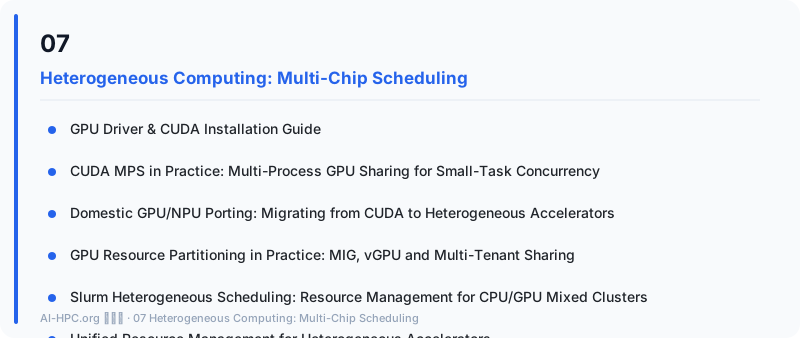
章节导航图

Chapter focus: In the era of multi-chip, multi-stack coexistence, the difficulty of heterogeneous computing lies less in "installing" than in "scheduling smoothly". This chapter covers four high-frequency engineering problems: driver/CUDA environments, GPU partitioning (MIG/MPS), CUDA-ecosystem migration for domestic accelerators, and Slurm heterogeneous scheduling.

🧭 Reading Map ​

  • Prerequisites: 06. Scheduling & Cloud + 03. Cluster Architecture — heterogeneous resources live within scheduling and topology
  • Role: closing chapter of Part 2, L2 — CUDA toolchain, MIG partitioning, multi-vendor mixing, domestic accelerator porting
  • Order: CUDA toolchain (install/MPS) → resource partitioning (MIG) → heterogeneous scheduling → domestic porting
  • Next: 09. AI Compiler — how code becomes fast GPU kernels

Articles ​

GPU Driver & CUDA Installation Guide
A step-by-step guide for installing NVIDIA GPU Drivers and CUDA Toolkit on Linux (CentOS/Ubuntu/SUSE), covering dependencies, persistence mode, and Fabric Manager.
阅读文章 →
CUDA MPS in Practice: Multi-Process GPU Sharing for Small-Task Concurrency
Reproducible commands dissecting CUDA MPS: positioning vs MIG, console/daemon deployment, small-task concurrency experiments, timeout and fault-isolation pitfalls, with engineering takeaways.
阅读文章 →
Domestic GPU/NPU Porting: Migrating from CUDA to Heterogeneous Accelerators
Reproducible flow dissecting domestic accelerator porting: the CUDA migration roadmap, Ascend and other domestic accelerator adaptation points, operator mapping and performance regression, dual-stack coexistence, with engineering takeaways.
阅读文章 →
GPU Resource Partitioning in Practice: MIG, vGPU and Multi-Tenant Sharing
In multi-tenant clusters an A100 often sits below 50% utilization: MIG (hardware partitioning), vGPU (virtualization) and soft memory/time-slice partitioning — principles, selection, Slurm integration with gres, and field pitfalls like isolation boundaries, NCCL communication and failure domains.
阅读文章 →
Slurm Heterogeneous Scheduling: Resource Management for CPU/GPU Mixed Clusters
Slurm heterogeneous node management, gres resource declaration, partition and QOS design, job submission templates, and scheduling strategy with common pitfalls for GPU/CPU mixed clusters.
阅读文章 →
Unified Resource Management for Heterogeneous Accelerators
GRES modeling, mixed strategies, isolation, observability.
阅读文章 →
## Suggested Reading Path

Start with environment setup and GPU partitioning (MIG/MPS); scheduling readers go to Slurm heterogeneous scheduling; migration readers go to domestic-accelerator porting.

Key Takeaways ​

The core of heterogeneous scheduling is "letting each chip run what it does best": raise small-task density with MIG/MPS, isolate architectures with Slurm partitions, and lower multi-stack maintenance with unified toolchains.

AI-HPC Expert · Contact: openaihpc@gmail.com