03. Cluster Architecture
Chapter focus: This chapter covers key steps from AI-HPC cluster design to benchmarking and tuning.
Outcomes
- baseline benchmark methods (HPL, STREAM)
- CPU/GPU cluster tuning patterns
- practical benchmark toolkit workflows
- MPI environment setup and parallel programming
🧭 Reading Map
- Prerequisites: 02. Hardware & Chips — benchmarks and topology here build on hardware knowledge
- Role: core chapter of Part 1, L1 — from capacity planning and CPU/GPU benchmarks to MPI parallelism and the L40S cluster delivery series; the longest, most delivery-oriented chapter
- Order: CPU theory→estimation→measurement (three steps) → MPI practice (4 articles) → GPU HPL → L40S series (10 articles incl. network/system/software stack) → benchmark toolkit
- Next: 03. Network — the ceiling of cluster performance lives in the network
Articles
CPU Performance Testing in Practice (Theory → Measurement)
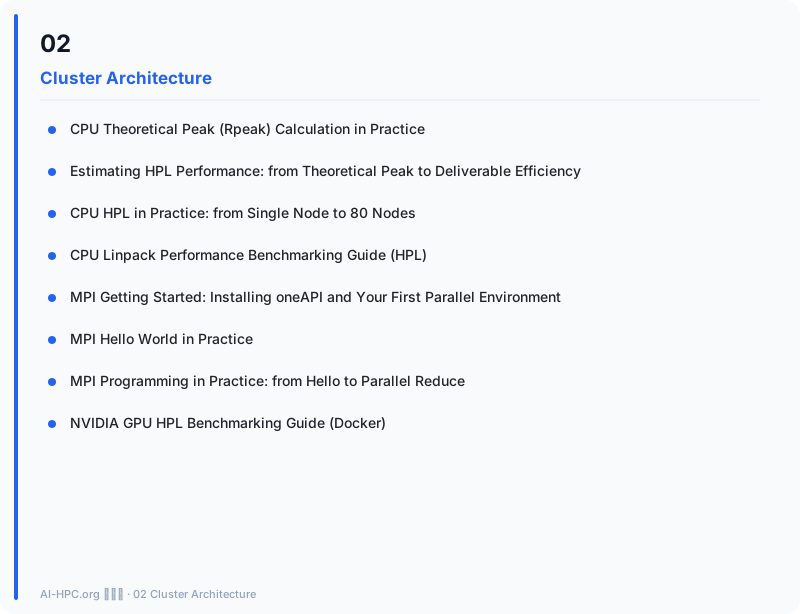
CPU Theoretical Peak (Rpeak) Calculation in Practice
compute Rpeak in three steps with real machine specs: AVX-512 32 FLOP/cycle, 104-core node, 80-node cluster; includes a lookup table and verification tools.
阅读文章 →
Estimating HPL Performance: from Theoretical Peak to Deliverable Efficiency
a 91-node per-node dataset: 93.4% single-node average efficiency, 78.3% at 80 nodes, 74.2% memory bandwidth, with a scaling-band estimation formula.
阅读文章 →
CPU HPL in Practice: from Single Node to 80 Nodes
full post-mortem of single-node tuning → 36 nodes → 80 nodes: HPL.dat configs, commands, real results, and pitfalls.
阅读文章 →
CPU Linpack Performance Benchmarking Guide (HPL)
a comprehensive HPL guide on Intel MKL: environment setup, HPL.dat tuning, multi-node testing, and performance analysis.
阅读文章 →
MPI Parallel Programming in Practice
MPI Getting Started: Installing oneAPI and Your First Parallel Environment
offline install of Intel oneAPI Base + HPC Toolkit, silent commands, environment loading, and common pitfalls.
阅读文章 →
MPI Hello World in Practice
compile, single-node multi-rank, and multi-node runs from hello.c, with rank output and fabric flags explained.
阅读文章 →
MPI Programming in Practice: from Hello to Parallel Reduce
compilable code from point-to-point Send/Recv to MPI_Reduce, implementing parallel summation with verification.
阅读文章 →
MPI Point-to-Point in Practice
ring relay with MPI_Sendrecv and a ping-pong latency/bandwidth probe, with cross-node fabric notes.
阅读文章 →
MPI Collectives in Practice: from Bcast to Allreduce
broadcast, parallel sum, and Allreduce global statistics with compilable code, mapped to the HPL P×Q grid.
阅读文章 →
MPI + Slurm in Practice: Scheduling and Performance Tuning
srun/sbatch submission, process layout and pinning, and an HPL tuning retrospective from 1 to 80 nodes.
阅读文章 →
GPU / Heterogeneous & Tools
NVIDIA GPU HPL Benchmarking Guide (Docker)
running HPL on NVIDIA GPUs via Docker: startup parameters, MPI commands, and result analysis.
阅读文章 →
AMD CPU Linpack (HPL) Performance Guide
HPL testing and tuning for AMD EPYC (Genoa/Zen 4): OpenMPI binding, BIOS settings, and multi-node scripts.
阅读文章 →
Memory Bandwidth Testing & STREAM Guide
server memory bandwidth evaluation with STREAM: DDR5 theoretical calculation, compiler optimizations, and case studies.
阅读文章 →
Building an All-in-One HPC Benchmark Toolkit
a portable, containerized toolkit integrating HPL, Intel oneAPI, STREAM, FIO, and OSU benchmarks.
阅读文章 →
GPU Cluster Capacity Planning: From Business Requirements to Racks & Power Budget
total compute, rack layout, power & cooling, cost & cadence.
阅读文章 →
384-GPU L40S IB Cluster: Engineering Thinking
48 nodes × 8×L40S + 4×200G HDR IB: three-plane separation, rail topology, lossless IB and the acceptance philosophy.
Read →
L40S Without NVLink: NCCL & Node Communication
Three implicit constraints, NUMA affinity, busbw baselines and an actionable tuning checklist.
Read →
IB Three-Plane Separation: PKey, SL/VL & IPoIB
Physical isolation of compute/storage/management, PKey 0x100/0x200 isolation, OpenSM failover and verification commands.
Read →
Rail Topology + 1.5:1 Oversubscription
Design a 48-node cluster like a 10K-GPU one: rail-optimized Fat-Tree, 2×200G breakout, SM auto-discovery and growth.
Read →
MLNX_OFED & VPI LINK_TYPE in Practice
Switch dual-mode adapters to IB: mstconfig burning, driver stack, ibstat/ibv_devinfo verification and traps.
Read →
Kickstart + Mirrors + Ansible Delivery
Version consistency across 48 nodes: bulk install, internal YUM/pip mirrors, Ansible rollout and acceptance.
Read →
openEuler Kernel & System Tuning
The BIOS checklist, kernel parameters, NUMA and IRQ affinity — each step verified.
Read →
CUDA Stack Pinning & Bulk Install
Driver/CUDA/cuDNN/NCCL version matrix, internal-mirror installs, NCCL knobs and verification.
Read →
Acceptance & Performance Baselines
Layered verification, archived baselines and layer-by-layer debugging — falsify, don't just run.
Read →
Power & Cooling: The 4.6kW Ledger
Per-node power math, rack density, power sequencing and full-load verification.
Read →