09. Deep Learning Frameworks
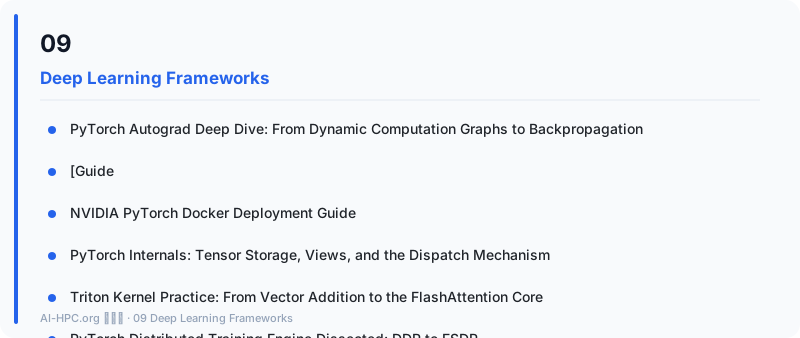
Chapter focus: This chapter covers runtime behavior and engineering deployment practices for mainstream frameworks.
Contents
- PyTorch environment and container setup
- training workload operations
- integration with scheduling systems
🧭 Reading Map
- Prerequisites: 09. AI Compiler — the framework operator layer builds on compiler output
- Role: closing chapter of Part 3, L3 — PyTorch runtime: Autograd/Dispatch, DDP/FSDP, container envs and Triton kernels
- Order: framework internals (Autograd/Dispatch) → distributed engines (DDP/FSDP) → environments (Docker) → hand-written kernels
- Next: 11. Pre-trained Models — with frameworks in place, build large models
Articles
PyTorch Autograd Deep Dive: From Dynamic Computation Graphs to Backpropagation
Step-by-step dissection of the PyTorch autograd engine with runnable experiment code: requires_grad, graph construction, backward execution, gradient accumulation and detach, plus memory and mixed-precision engineering lessons.
阅读文章 →
PyTorch Internals: Tensor Storage, Views, and the Dispatch Mechanism
Reproducible experiments dissecting PyTorch internals: the storage/view/stride data model, the dispatch mechanism beyond autograd, and device/dtype routing, with engineering takeaways.
阅读文章 →
PyTorch Distributed Training Engine Dissected: DDP to FSDP
gradient buckets, comm-compute overlap, sharding, selection matrix.
阅读文章 →
Training Framework Ledger: Megatron vs DeepSpeed
Four-layer abstraction, Megatron TP/PP/SP, DeepSpeed ZeRO/Offload, selection matrix & combos.
阅读文章 →