09. AI Compiler
Chapter focus: This chapter focuses on compiler techniques that turn model graphs into high-performance kernels.
You Will Learn
- Triton kernel optimization patterns
- heterogeneous toolchain setup with oneAPI
- strategy differences between training and inference compilers
🧭 Reading Map
- Prerequisites: 08. Heterogeneous Computing — compilers generate code for heterogeneous hardware; understand the abstraction first
- Role: opening of Part 3, L3 — MLIR/Triton/compilation pipelines, the "model graph → high-performance kernels" middle layer
- Order: why compilers (Triton path) → MLIR architecture → PyTorch compile stack → hands-on Triton
- Next: 10. Frameworks — how the framework schedules what compilers produce
Articles
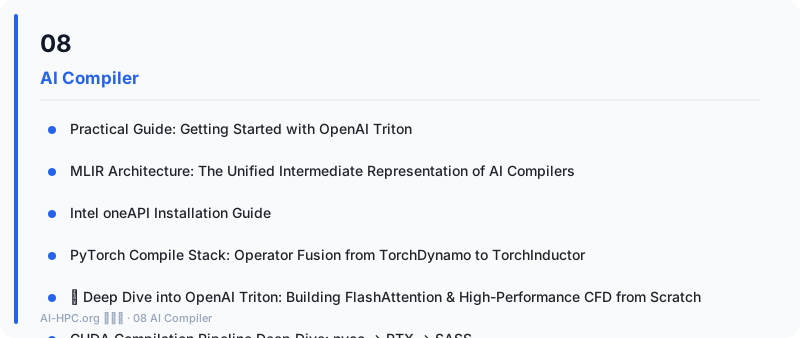
Practical Guide: Getting Started with OpenAI Triton
A deep dive into OpenAI Triton compiler, from environment setup to writing your first high-performance Vector Add kernel.
阅读文章 →
MLIR Architecture: The Unified Intermediate Representation of AI Compilers
Reproducible compile commands and IR samples dissecting MLIR: dialect layering, operations and SSA, the IR lowering pipeline, and its relationship to Triton/XLA, with engineering takeaways.
阅读文章 →
Intel oneAPI Installation Guide
A comprehensive guide for installing Intel oneAPI Base & HPC Toolkits, configuring environment variables, and running MPI tests.
阅读文章 →
PyTorch Compile Stack: Operator Fusion from TorchDynamo to TorchInductor
Reproducible scripts dissecting the PyTorch compile stack: TorchScript/TorchDynamo/TorchInductor positioning, torch.compile measured gains, fusion mechanics, IR tracing, and production mode selection, with engineering takeaways.
阅读文章 →
🚀 Deep Dive into OpenAI Triton: Building FlashAttention & High-Performance CFD from Scratch
Author: Technical Learner (Root User) Environment: Python 3.12 + NVIDIA GPU (A100/H100 Level)
阅读文章 →
CUDA Compilation Pipeline Deep Dive: nvcc → PTX → SASS
two-stage compilation, gencode combos, artifact analysis.
阅读文章 →
How AI Compilers Work: Fusion, Kernels, Autotuning
Three-layer structure, fusion types & gains, three autotuning routes, and the torch.compile stack.
Read →
Triton Kernel Practice: From Vector Addition to the FlashAttention Core
Reproducible scripts dissecting hand-written Triton kernels: vector addition, tiled GEMM, softmax and the FlashAttention core, with performance comparisons and tuning (block size/loop unrolling), and engineering takeaways.
阅读文章 →